
How to Check Your PPF Layout Before Cutting in YINK
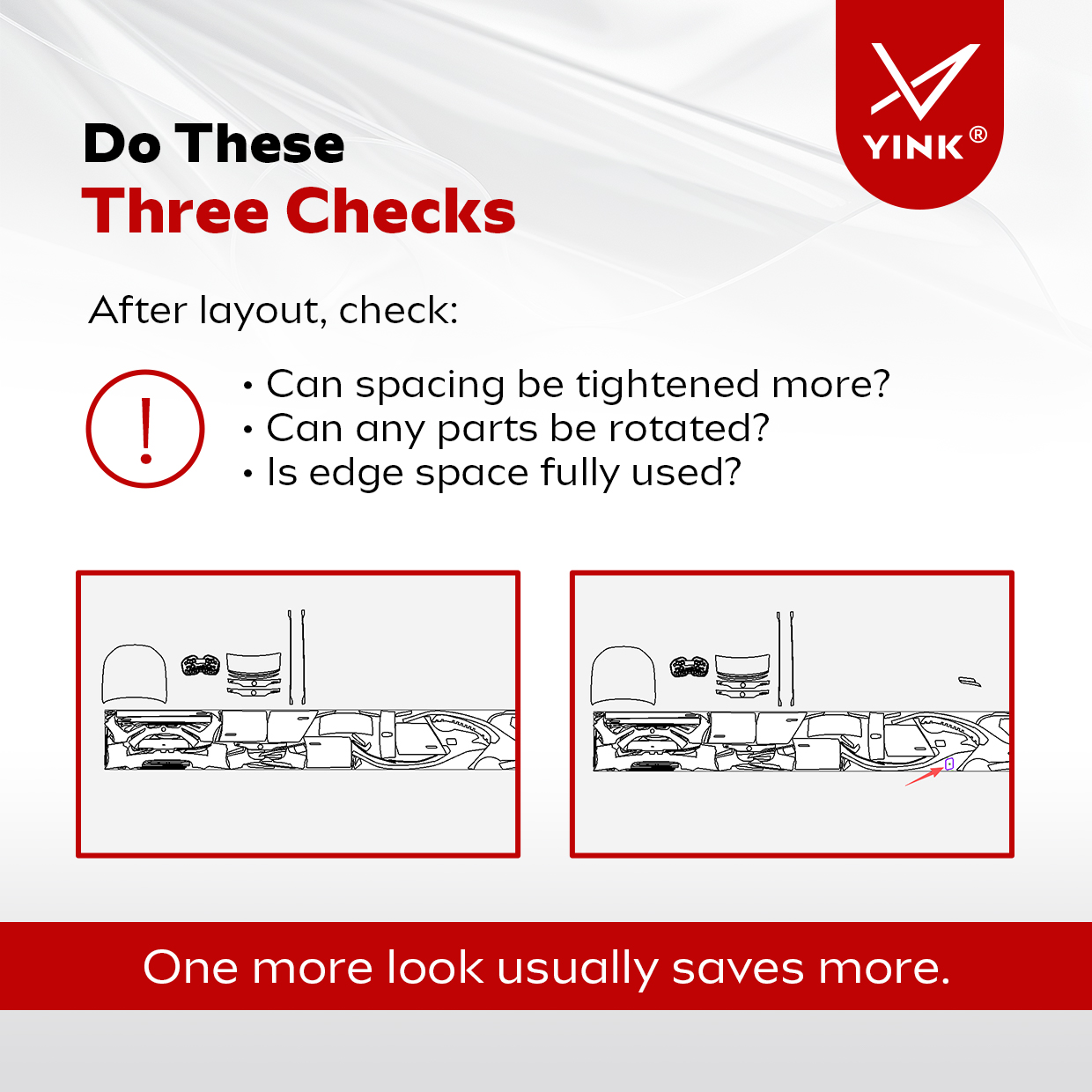
A PPF layout deserves one final check before cutting. Even after automatic nesting, it is useful to review the spacing between patterns, the orientation of individual pieces, and the unused areas near the edges.
The aim is to find a more compact, practical arrangement without compromising the patterns or the space needed for cutting. In YINK, you can start with Super Nesting, then review the result and make manual adjustments where appropriate.
Why Should You Check the Layout Before Cutting?
Unused film can remain between patterns or beside the arranged pieces. Some of that space may be necessary for cutting, while other gaps may offer an opportunity to improve the arrangement.
A final review helps you distinguish between the two. Rather than moving every piece, focus on areas where a small adjustment could reduce the overall film length required.
A layout that looks tighter is only useful if it remains suitable for cutting. Do not reduce spacing simply to make the screen appear more crowded, and do not change a pattern’s size or shape to make it fit into a gap.
What Should You Check After Super Nesting?
Check the Spacing Between Patterns
Look for gaps that appear larger than necessary, especially between pieces with complementary outlines.
Where suitable, reposition the pieces to bring them closer together. Keep sufficient separation so that the patterns remain distinct and their cutting paths do not overlap.
Use workable cutting clearance as the limit for adjustment. The goal is to reduce avoidable empty space, not to remove every gap.
Check Whether Individual Pieces Can Be Rotated
Some pieces may fit more efficiently when their orientation changes. A narrow section of one pattern, for example, may fit beside a curved section of another.
Before rotating a piece, check whether the film or the job has any directional requirements. If orientation matters, preserve it.
Rotation is an option to evaluate, rather than a required adjustment for every pattern.
Check Unused Space Near the Edges
Review the space beside the arranged patterns. A smaller piece may fit into an unused area and reduce the length occupied by the complete layout.
However, visible blank space is not automatically usable cutting space. Keep every piece within the usable cutting width and preserve the margins required by your machine and material setup.
Do not move a pattern into an edge area simply because it appears empty on screen.
How Do You Combine Super Nesting with Manual Adjustments?
01 Run Super Nesting
Click Super Nesting to generate an automatic arrangement.
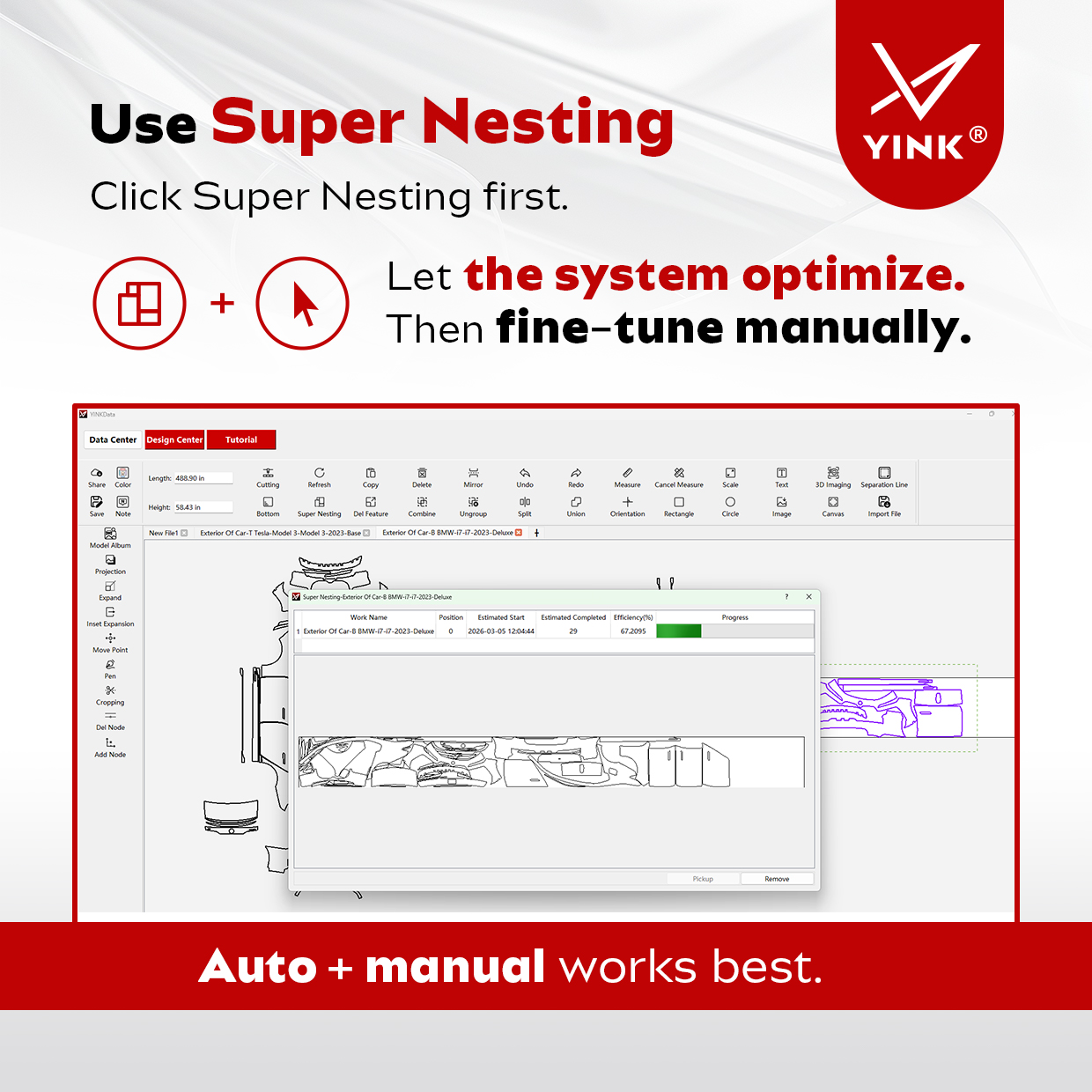
02 Review the Complete Layout
Check the spacing between patterns, the orientation of individual pieces, and unused edge areas. Identify specific opportunities before making changes.
03 Make Targeted Adjustments
Where appropriate, reposition or rotate selected pieces. Preserve pattern geometry, required orientation, cutting clearance, and usable material boundaries.
04 Check the Result Again
Review the complete arrangement after editing. Confirm that no patterns overlap and that every piece remains within the usable cutting area.
Compare the overall film length required before and after your adjustments. Keep the revised arrangement if it offers a useful improvement and remains suitable for cutting.
For visual guidance on the interface and cutting tools, explore the YINK Software V6 video tutorials. Interface details may differ between software versions.
Does Manual Adjustment Always Save More Film?
No. The automatic result may already be suitable, and further changes may offer little benefit.
The outcome depends on the combination of patterns, the available film width, the permitted orientations, and the cutting clearances required. A useful final check may lead to an adjustment, or it may confirm that the existing layout is ready.
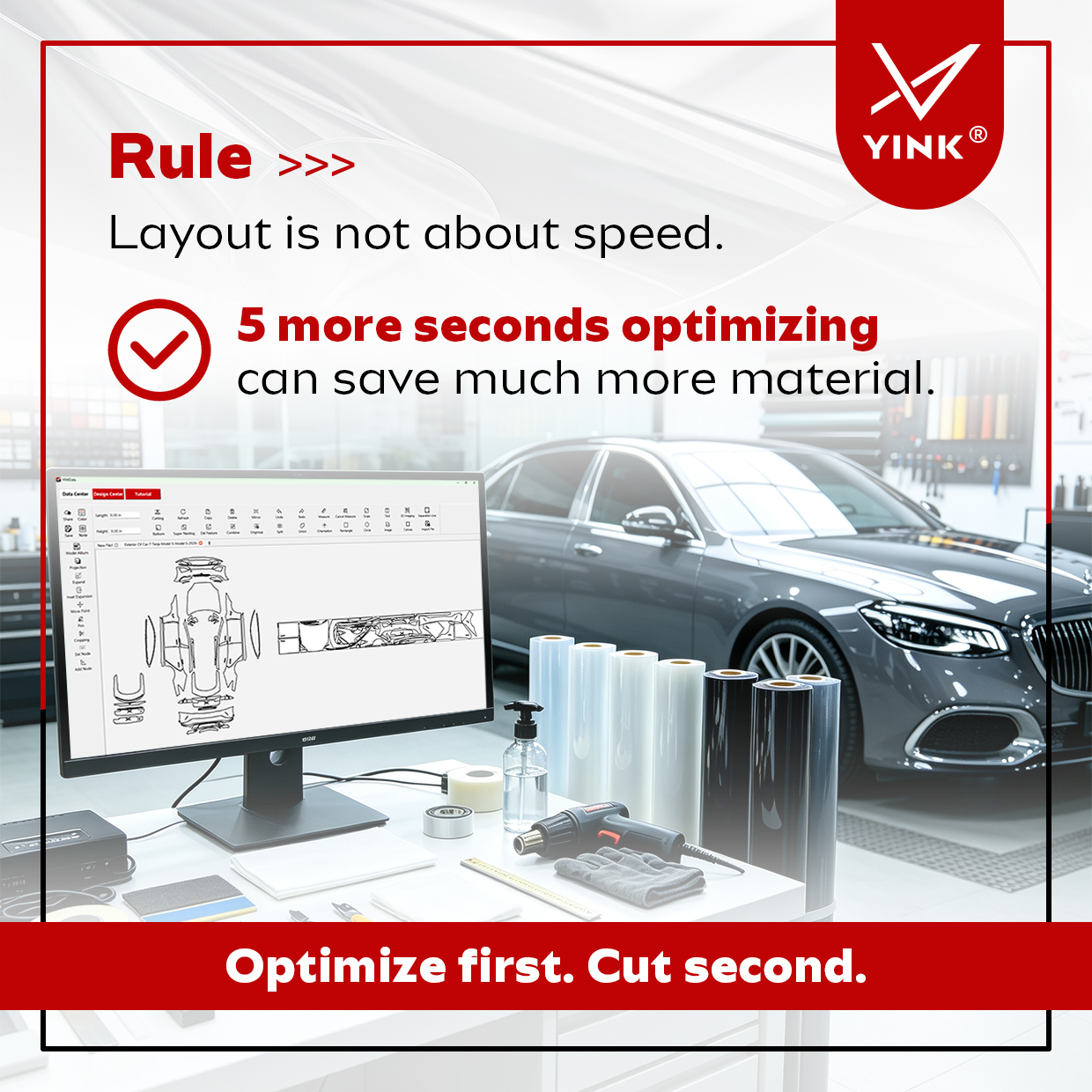
There is no fixed amount of film saved by spending a few more seconds on a layout. Any saving should be assessed using the actual job, with the same patterns and material settings.

Final Check Before Cutting
Use Super Nesting to prepare the arrangement, then review the details before sending the job to cut.
Focus on three practical questions: Can unnecessary gaps be reduced? Can suitable pieces be rotated? Can unused edge space be used safely?
The principle is straightforward: optimize first, verify the layout, then cut.
Post time: Nov-04-2026


